
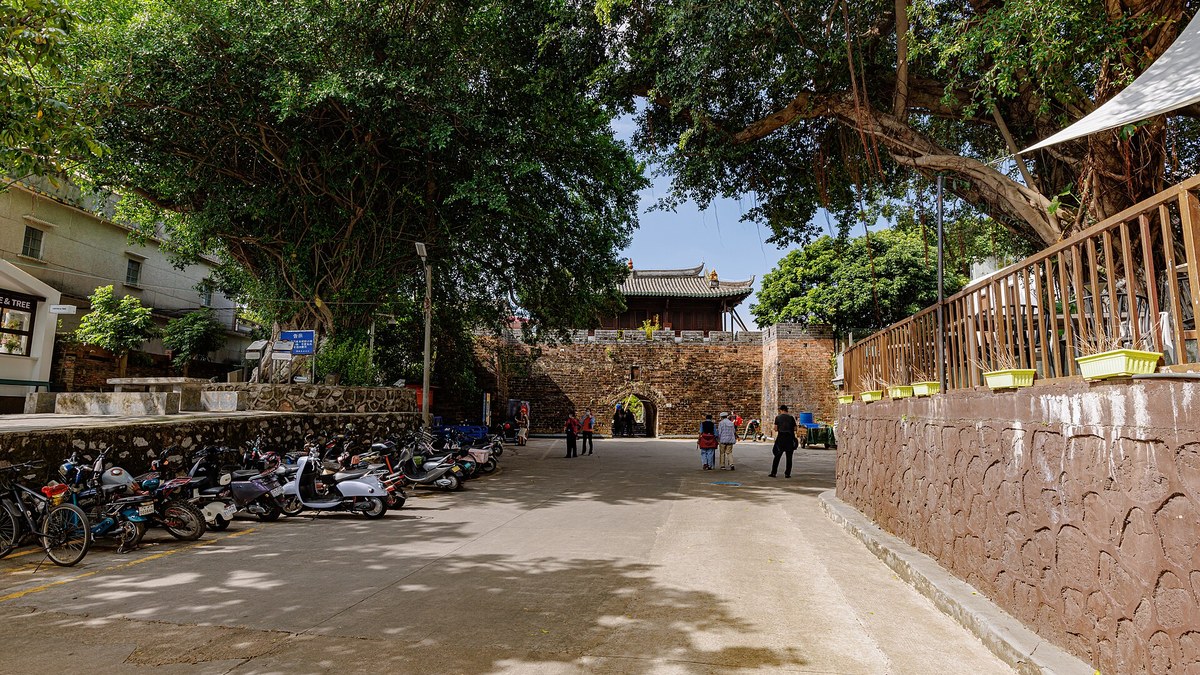
Shenzhen is often joked about as having "no history," but in fact the city and its surroundings have preserved quite a few ancient villages, old market towns and military forts: there's a 600-year-old coastal defence fort, Hakka walled-village settlements, and revitalised old market streets. All 5 of these places are free to enter, not far from metro stations, and perfect for a half-day trip — and you can grab a meal nearby afterwards.
| Place | District | Metro | Admission | Suggested time |
|---|---|---|---|---|
| Nantou Ancient Town | Nanshan District | Line 12, Nantou Ancient Town Station, Exit A | Free | 2–3 hours |
| Dapeng Fortress | Dapeng New District | Line 8, Xichong Station / Line 2, Liantang Checkpoint Station, then bus | Free | Half day to a full day |
| Gankeng Hakka Town | Longgang District | Line 10, Gankeng Station, Exit A | Free | 2–4 hours |
| Guanlan Old Market | Longhua District | Line 4, Guanlan Station, then taxi | Free | 1.5–2 hours |
| Shajing Old Market | Bao'an District | Line 11, Shajing Station, then taxi | Free | 1.5–2 hours |
1. Nantou Ancient Town (Nanshan District) — the root of the city of Shenzhen
Nantou Ancient Town has nearly 1,700 years of history and is the old site of the administrative centre of the Shenzhen–Hong Kong region. The town is a mix of old and new: on one hand it retains its city gate, memorial archways and old houses, while on the other it's home to design boutiques, cafés and exhibition spaces. Half a day here won't bore you, and the lighting at night is great for photos.
- Area: Nantou Subdistrict, Nanshan District (beside Shennan Boulevard)
- Transport: Metro Line 12, Nantou Ancient Town Station, Exit A, about a 5-minute walk; from Shenzhen Bay Checkpoint, take Line 13 and transfer to Line 12, about 30 minutes
- Cost: Free entry; individual exhibitions and workshops charge separately, and shops generally open 10:00–22:00
2. Dapeng Fortress (Dapeng New District) — a 600-year-old coastal defence fort
Dapeng Fortress covers about 110,000 square metres and was a coastal defence military stronghold in the Ming and Qing dynasties. Inside are the old city gate, generals' residences and many old houses; some attractions (such as the museum) may charge separately. It's open all day with free admission, and afterwards you can head to Jiaochangwei beach nearby.
- Area: Pengcheng Community, Dapeng New District
- Transport: Get off at Line 8, Xichong Station or Line 2, Liantang Checkpoint Station, transfer to express bus E11, E91 or 833 to Dapeng Centre, then transfer to M471/M457 to Dapeng Fortress Station and walk 5–6 minutes to the South Gate; the whole journey takes about 1.5–2 hours
- Note: On holidays, entering Dapeng usually requires a reservation — register via official channels before you set off
3. Gankeng Hakka Town (Longgang District) — a Hakka walled-village settlement
Revitalised from an old Hakka village, it has walled houses, watchtowers, the Liangmao Theatre and creative boutiques. By day you can admire the architecture and exhibitions, and at night when the lanterns light up it takes on a whole different atmosphere. Entry is free, while some experience activities (Hanfu dress-up, handicrafts) charge separately.
- Area: Gankeng Community, Jihua Subdistrict, Longgang District
- Transport: Metro Line 10, Gankeng Station, Exit A, about a 10-minute walk; from Futian Checkpoint, Line 10 goes direct in one ride — the most convenient of the three checkpoints
- Hours: The park is open all day; shops and exhibition halls generally open 10:00–22:00
4. Guanlan Old Market (Longhua District) — a revitalised old market town
Guanlan Old Market was a market town in days gone by, and after restoration it has become a pedestrian street area lined with old arcade shops. At night there's a lighting display, and nearby there are creative spaces around the Guanlan Printmaking Base — great for strolling and photos.
- Area: Around Guxu Street, Guanlan Subdistrict, Longhua District
- Transport: Get off at Metro Line 4, Guanlan Station, then a short taxi or bus ride of about 5–10 minutes
- Cost: Free entry; best visited in the early evening when it's cooler and the lighting is lovely
5. Shajing Old Market (Bao'an District) — an oyster-town old market plus ancestral halls
The Shajing area is Shenzhen's famous oyster town, and the old market retains its old streets and ancestral hall architecture, having reopened after restoration in recent years. You can pair it with oyster season (autumn and winter): stroll the old market, then eat oysters for a complete itinerary.
- Area: Shajing Subdistrict, Bao'an District
- Transport: Get off at Metro Line 11, Shajing Station, then a short taxi ride of about 10 minutes
- Cost: Free entry; some historic sites and exhibition halls have set opening hours — check on-site notices
6. Where else to go nearby
Right next to Nantou Ancient Town are Zhongshan Park and the Nanshan Museum area, which together make a half-day culture route; near Gankeng is the Longgang district shopping area, and back in the city centre in the evening you can also eat at Nanshan MixC World or Coastal City; and when visiting Dapeng Fortress you can drop by Jiaochangwei beach on the way and then return to Yantian for seafood. Couples or groups of friends might consider the combo "Nantou Ancient Town → Zhongshan Park → MixC World," all connected by Metro Line 12 and Line 1 — no need to call a car.
7. Itineraries and tips
- Half-day route (city centre): Nantou Ancient Town in the morning → lunch inside the town → transfer by metro to Gankeng in the afternoon, then head back to Hong Kong after seeing the night lights.
- Full-day route (east): Dapeng Fortress → Jiaochangwei beach → dinner at Yantian Seafood Street; crossing via Liantang/Heung Yuen Wai Checkpoint is the smoothest.
- Ancient villages are mostly outdoor pedestrian areas, so bring water and a hat in summer; stone-paved paths get slippery in the rain, so wear comfortable shoes.
- When entering ancestral halls or walled houses, pay attention to signs — don't be noisy and don't touch the exhibits; drone flying is banned in some places.
- Both Gankeng and Nantou Ancient Town have Hanfu rental and handicraft workshops, generally ¥50–200 per person; book ahead if you want photos.
- On holidays crowds peak between 11:00–16:00; for better photos, arrive before 09:00 or go on a weekday.
8. Frequently asked questions
Do these places charge admission?
All five are free to enter; individual exhibition halls or experience activities inside Nantou Ancient Town, Gankeng and Dapeng Fortress charge separately, with prices as posted on site.
Is a same-day return trip from Hong Kong enough time?
The city-centre spots, Nantou Ancient Town and Gankeng, can be done in half a day, so a same-day return is more than enough; Dapeng Fortress is a longer journey, so allow a full day, or combine it with Jiaochangwei and Yantian.
Which checkpoint is most convenient?
For Gankeng, Futian Checkpoint (direct on Line 10) is fastest; for Nantou Ancient Town, Shenzhen Bay Checkpoint is closest; for Dapeng and Yantian, Liantang/Heung Yuen Wai Checkpoint is recommended, connecting most smoothly to the eastern bus routes.
Is there food at the old markets?
Nantou Ancient Town and Gankeng have plenty of restaurants and cafés, and Shajing has oyster-themed eateries; Guanlan Old Market has fewer options nearby, so it's best to eat back in the city centre, for example at Nanshan MixC World or Coastal City.
Can I visit on a rainy day?
Nantou Ancient Town, Gankeng and Guanlan Old Market all have indoor shops and exhibition halls, so you can still go when it rains; Dapeng Fortress and Shajing Old Market are mainly outdoor, so heavy rain makes for a poorer experience — better to reschedule.
Do I need to make a reservation?
Most are open free of charge with no reservation needed; but on holidays, entering the Dapeng Peninsula (including Dapeng Fortress) usually requires advance registration via official channels, and places are limited, so remember to check notices before you set off.
Sources
9. Bonus: Shenzhen's six great Hakka walled villages and art villages
After seeing the five ancient villages and old markets above, if you're interested in Hakka architecture, Shenzhen actually has several more "walled" compounds and art villages worth visiting — all at the level of protected heritage sites, and some free to enter:
- Hefu Xinju (Longgang Hakka Folk Museum) (No. 1 Luoruihe North Street, Longyuan Road, Longgang Subdistrict, Longgang District): Built by the Luo family during the Qianlong reign of the Qing dynasty and completed in the 22nd year of Jiaqing (1817), it covers about 25,000 square metres and is one of the largest Hakka square castle-style walled compounds in the country, known for its "nine skies and eighteen wells, ten pavilions and a horse-riding corridor," and houses more than 400 Hakka artefacts. Get off at Metro Line 3, Nanlian Station, then take a taxi for about 10 minutes. Admission about ¥10, subject to on-site notice.
- Dawan Shiju (No. 33 Dawan Road, Pinghuan Community, Malan Subdistrict, Pingshan District): Built by the Zeng family in the 56th year of Qianlong (1791), it covers 25,000 square metres with more than 400 rooms, and is one of the largest and best-preserved square Hakka walled compounds in the country. About a 19-minute walk from Metro Line 16, Pinghuan Station; free to visit, with some exhibition halls charging separately.
- Longtian Shiju (Tianduanxin, Longtian Subdistrict, Pingshan District): Completed in the 17th year of Daoguang (1837), covering more than 16,000 square metres, listed as a Guangdong Provincial Cultural Relic Protection Unit in 2002; it's fairly remote, so it's best to call a car from the Pingshan central area.
- Maosheng Shiju (east side of No. 184 Maosheng Road, Silian Community, Henggang Subdistrict, Longgang District): Built by the He brothers between the Jiaqing and Daoguang reigns and completed over 13 years, it covers more than 10,000 square metres, with a moon pond in front and a feng shui woodland behind, and is one of the best-preserved large Hakka residences in Shenzhen; about a 10-minute taxi ride from Metro Line 3, Henggang Station.
- Shangwei Art Village (Shangwei Old Village, Zhangkengjing Community, Guanhu Subdistrict, Longhua District): A Hakka ancient village of about 400 years, with 5 century-old watchtowers and nearly 50 old Hakka houses still standing; since 2017 nearly a hundred artists have moved in, and the village has the China Historical Irons Museum, the Shangwei Film Museum and the Shangwei Contemporary Art Museum; free with no reservation, Metro Line 10, Xuexiang Station, Exit D, then a taxi.
- Aohu Art Village (Niuhu Community, Guanlan Subdistrict, Longhua District): Founded around 1706, it retains 5 ancestral halls, 6 watchtowers and more than 100 Hakka terraced houses, and is the largest gathering place of local Shenzhen artists; free with no reservation, Metro Line 4, Niuhu Station, Exit B.
A reminder: most walled villages and ancient villages are heritage buildings, so don't be noisy and don't touch the exhibits when visiting; some walled houses still have residents or caretakers inside, so it's best to ask before taking photos. Opening hours, admission and reservation arrangements are subject to each site's latest announcements.
Compiled from official announcements by Shenzhen attractions, Shenzhen Bendibao and mainland media public information from 2026. Opening hours and reservation arrangements are adjusted seasonally; before setting off, please refer to the attractions' official channels and real-time information on Amap.


💬 Comments
Loading…