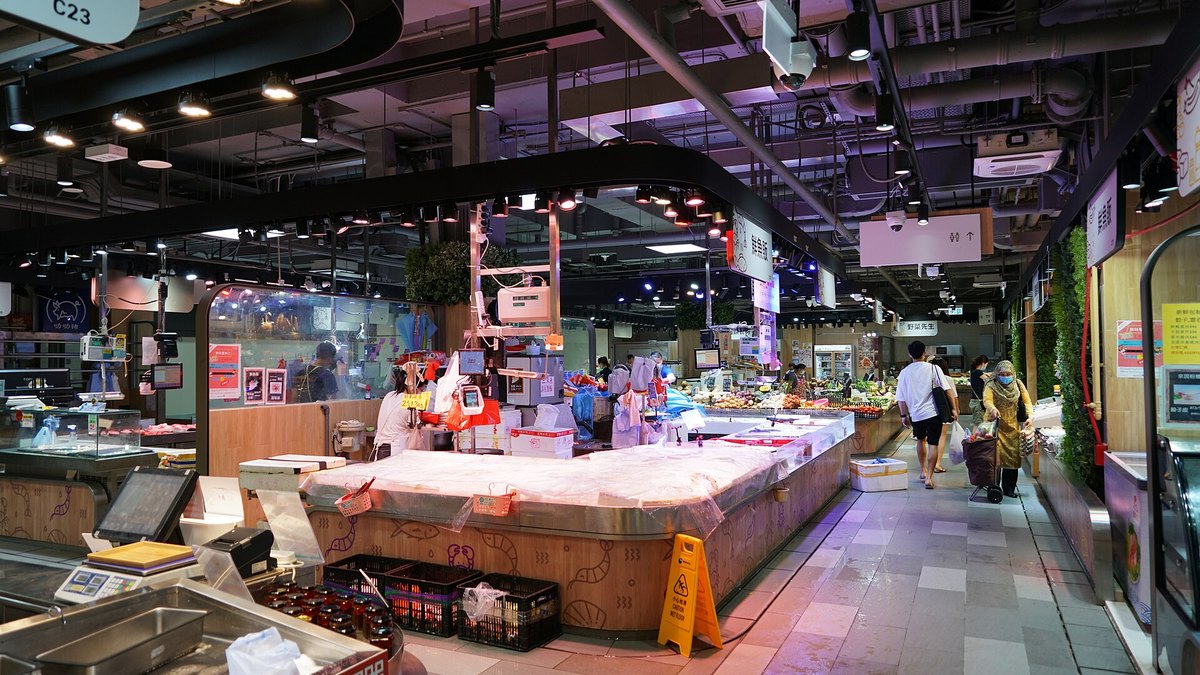
On the eve of the Mid-Autumn Festival and National Day long holiday, Shenzhen's major agricultural wholesale markets and wet markets are once again packed with Hong Kong people. Buying groceries to bring back to Hong Kong is no longer just a "casual add-on" — some Hong Kong people make a dedicated same-day round trip for it: roast pork, seafood, seasonal fruit, soup ingredients, braised meats. For the same catty, Shenzhen prices are generally only 30% to 50% of Hong Kong's. At the exchange rate on 20 September 2026, ¥1 is about HK$1.17, meaning a catty of crispy roast pork at ¥20 works out to about HK$23, while the same grade of roast pork at a Hong Kong wet market averages close to HK$100 a catty.
Below are the prices found on the ground and in media reports in September 2026, plus transport and opening hours for 5 markets. Note that there are legal restrictions on bringing meat and eggs across the border — this is explained clearly at the end of the article.
Shenzhen vs Hong Kong price comparison, item by item (September 2026)
| Item | Shenzhen price | In HK$ | Hong Kong reference price |
|---|---|---|---|
| Crispy roast pork (per catty) | ¥15–28 | About HK$18–33 | Close to HK$100 |
| Qingyuan chicken (whole) | ¥55 | About HK$64 | From HK$120 |
| Lion-head goose (per catty) | ¥35–58 | About HK$41–68 | Rare; more than double at braised meat shops |
| Chaoshan hand-beaten beef balls (per catty) | ¥55 | About HK$64 | From HK$120 |
| Baby cabbage (per catty) | ¥3 | About HK$3.5 | HK$12–16 |
| Bananas (per catty) | ¥2 | About HK$2.3 | HK$8–10 |
| Dandong strawberries (per catty) | ¥22–30 | About HK$26–35 | From HK$60 |
| Blueberries (per box) | From ¥12 | About HK$14 | HK$25–40 |
| Farm-raised local pork (per catty) | ¥38 | About HK$44 | From HK$80 |
In other words: for a family of four to buy a full week's groceries, Shenzhen makes it possible for ¥300–400 (about HK$350–470), while the same quantity in Hong Kong would cost roughly HK$900 or more — the price difference alone covers the transport cost. Assuming you cross at Luohu and take the metro both ways, the fare is only ¥4–8.
Market 1: The five wet markets in the Liantang area (Luohu District, closest to the border)
The area around Liantang Port is where Hong Kong people buy groceries most intensively. Once you exit the border you can walk there without even taking a bus, and there are at least 5 wet markets in the area, forming a "cheap groceries street". All prices below were verified in September 2026.
- Liantang Comprehensive Market (72-1 Guowei Road, Luohu District): about a 7-minute walk from Exit D of Liantang Station on Line 2. Crispy roast pork on special at ¥20 a catty (it tends to sell out around 5pm), while other stalls average ¥28 a catty. The chicken stalls can steam it on the spot and bag it for you, making it easy to bring back to Hong Kong.
- Xingangwan Market (163 Jubao Road, Luohu District): about a 4-minute walk from Exit D of Liantang Station on Line 2. Newly opened, its gimmick is "spend ¥10 and get a free gift": Shanwei cherry tomatoes at ¥10 for two boxes, strawberries at ¥10 a box, blueberries at ¥15 for two boxes; you must try the lychee-wood charcoal roast goose, and farm-raised local pork is ¥38 a catty. There is a restaurant next door, so you can go straight for dim sum after shopping.
- Sen Zhao Meat and Vegetable Market (72-12 Guowei Road, Luohu District): about a 5-minute walk from Exit B of Xianhu Road Station on Line 2. Before closing time, crispy roast pork is ¥15 a catty, large pork ribs ¥35 a catty, and Chaoshan beef balls ¥55 a catty (free samples available).
- Aoxia Meat and Vegetable Market (Songyuan Building, Guowei Road, Luohu District): connected to Sen Zhao, which is why it has the name "cheap groceries street". Qingyuan chicken at ¥55 each, lion-head goose at ¥35 a catty, baby cabbage at ¥3 a catty, bananas at ¥2 a catty; there are five or six roast meat and braised food stalls, driving each other's prices down.
- Xianglian Market (Xilingxia Village, Liantang area, Huangbei Subdistrict, Luohu District): adjacent to Liantang Port — turn right after exiting the border and walk straight. The signs are in traditional Chinese characters, clearly targeting Hong Kong customers; vegetables are ¥2–5 a bunch, white-cut chicken / salt-baked chicken / soy sauce chicken is ¥68 for half, and lion-head goose is ¥58 a catty for both the upper and lower cuts. Inside there are also hotpot, Chaoshan noodles and dessert shops to fill you up.
Market 2: Futian Agricultural Products Wholesale Market (Futian District, the most complete)
Futian Agricultural Wholesale Market is four storeys tall and is the most complete agricultural products wholesale venue in the urban area: the first floor has flowers, pets, grains and oils, Chinese medicinal herbs, dried seafood and fresh seafood; the second floor is a whole street of vegetables, fruit and soup ingredients; the third floor is mainly frozen meat. Opening hours are 08:00–18:00 daily, and you can spend one to two hours there without finishing it.
Transport is very convenient: take Exit C of Meijing Station on Line 9, turn left and walk 20 metres, then turn right and walk 50 metres, and you are at the market's southeast gate — about 1 minute in total. From Futian Port you can take Line 4 to Shangmeilin and transfer to Line 9 (about 40 minutes, ¥3), or take bus M499 to Meilin Yicun Terminus (¥2); from Luohu Port, Line 9 goes directly to Meijing Station in about 45 minutes for ¥4.
On prices, the cheapest seen were mangoes at ¥2 a catty, Hongyan Dandong strawberries at ¥22 a catty, freshly cut strawberries at ¥30 a pound (about 12 pieces for ¥24), small pets such as hamsters at ¥15–30 each, and a birdcage with 3 birds for ¥200. If you want dinner, a 10-minute walk away there is a boiled fish restaurant with a ¥99 two-person suancai fish (snakehead fillets, shrimp, squid) that is great value.
Market 3: Nanshan Agricultural Products Wholesale Market (Nanshan District, near Shenzhen Bay Port)
Nanshan Agricultural Products Wholesale Market is a well-known agricultural trading centre in Nanshan District, selling frozen goods, fruit and flowers. The fruit section alone brings together more than 100 specialities — Xinjiang Hami melon, American seedless red grapes and other fruits that are normally pricey in Hong Kong can be weighed out one by one here. From Shenzhen Bay Port, take Line 12 to Exit D of Tongle South Station and walk about 6 minutes; among the three port areas, this is the agricultural wholesale market most directly reachable from Shenzhen Bay Port.
Note that this market focuses on fruit, frozen goods and dried goods. If you want roast meats and fresh meat, go to the Liantang area or Futian Agricultural Wholesale Market.
Market 4: Haijixing International Agricultural Products Logistics Park (Longgang District, the largest in the city)
Haijixing is on Dannong Road in Longgang District and is Shenzhen's only first-tier comprehensive agricultural products wholesale market. It consists of 4 large buildings, and locals rely on it for Lunar New Year shopping and restaurants for their supplies. It focuses on fruit, frozen goods, agricultural food and tea, with prices at the lowest tier in the city: Dandong strawberries at ¥23 a catty and blueberries averaging ¥12 a box.
Transport: take Exit A of Danzhutou Station on Line 3, then transfer to bus M485 (get off at Haijixing Bus Terminus). As it is fairly far out, it is best combined with a day trip around Longgang rather than a dedicated grocery-only trip.
Market 5: Sungang and Huaqiangbei wholesale markets (festival supplies + snacks)
Besides groceries, festivals also call for mooncakes, sweets, red packets and lantern decorations. These two wholesale venues are in Luohu/Futian and both are directly accessible by metro:
- Sungang Toys, Stationery and Gifts Wholesale Market (1003 Bao'an North Road, Luohu District): Exit D of Yuanling Station on Line 9. Shenzhen's largest stationery and toy wholesale market, four floors, with festive supplies, lanterns, hanging decorations and red packets from about ¥3 — nearly half the price of Hong Kong's toy street.
- Zijingcheng Food Trading Centre (25 Zhenxing Road, Futian District): Exit B of Huaqiangbei Station on Line 2. A large imported snacks wholesale mall with a full range of sweets, biscuits and gift boxes. Netizens share that "even buying one item gets the wholesale price", but some shops do not display prices, so compare before you buy.
Getting there from three ports (transport quick reference)
| Port | To Liantang area markets | To Futian Agricultural Wholesale Market | To Nanshan Agricultural Wholesale Market |
|---|---|---|---|
| Luohu Port | Line 1 to Guomao Station, transfer to Line 2 to Liantang Station (about 30 minutes) | Exit C of Meijing Station on Line 9 (about 45 minutes, ¥4) | Line 1 to Convention & Exhibition Center, transfer to Line 12 to Tongle South Station |
| Futian Port | Line 4 to Convention & Exhibition Center, transfer to Line 2 to Liantang Station | Line 4 to Shangmeilin, transfer to Line 9 to Meijing Station (about 40 minutes, ¥3) | Line 4, transfer to Line 12 to Tongle South Station |
| Shenzhen Bay Port | Line 13 to Houhai Station, transfer to Line 2 to Liantang Station (further) | Bus M123 to Gaoxin South Station, transfer to Line 9 (about 45 minutes, ¥4) | Exit D of Tongle South Station on Line 12, walk 6 minutes |
Bringing groceries back to Hong Kong across the border: what you can and cannot bring
Even with low prices, you still have to follow the rules. Under Hong Kong's Imported Game, Meat, Poultry and Eggs Regulations, these are the points many Hong Kong people have been caught out by:
- Raw meat is absolutely not allowed: no raw meat may be brought in. If you want to bring meat, make sure it is fully cooked (no blood in the centre). Most meat stalls in Shenzhen wet markets can cook it thoroughly for you — ask clearly before ordering.
- Eggs are not allowed: chicken eggs are banned from entry whether in shell or not, raw or cooked, chilled or dried; fully cooked eggs as a food ingredient are not subject to this restriction.
- Seafood, fruit and vegetables are allowed: as long as they are not endangered species, seafood, fruit and vegetables can be brought back to Hong Kong. It is best to seal them in fresh-keeping bags to avoid leakage on the way; vegetables and plants with soil cannot be brought in.
- Quantity must be reasonable for personal use: if the amount clearly exceeds what a household would consume, customs has the right to question it as commercial use and detain it.
The above regulations are subject to the latest announcements by Hong Kong Customs and the Centre for Food Safety; it is best to confirm once more before you set off.
Practical tips
- Timing: wet markets are mainly open 08:00–18:00, and discounted roast pork is usually cleared out between 4pm and 5pm. Go early to grab bargains, or go in the morning to get a full range.
- Payment: most wet markets in the Liantang area accept electronic payment (WeChat Pay / Alipay) and cash; some stalls at Xingangwan Market only accept QR code payment, so remember to link your card first.
- Keeping things fresh: bring a cooler bag and ice packs, and head back as soon as you have bought seafood and frozen meat — do not visit several more shopping malls first.
- Do not trust Xiaohongshu alone: some "cheap gem shops" show old or advertised prices; asking in person on the ground is the most accurate.
FAQ
How much can Hong Kong people bring back to Hong Kong when buying groceries?
There is no hard weight limit in the regulations, but it must be reasonable for personal use. Generally, buying a catty or two of roast pork and a few catties of vegetables and fruit is no problem; if you are hauling it back box by box, customs has the right to treat it as commercial use and detain it.
Which market is most convenient for buying groceries in Shenzhen?
If you cross at Liantang Port, the Liantang area (Liantang Comprehensive Market, Xingangwan Market, Sen Zhao, Aoxia) is the most convenient with no transfers; if you cross at Futian Port, Futian Agricultural Wholesale Market (Exit C of Meijing Station) is the most direct; if you cross at Shenzhen Bay Port, go to Nanshan Agricultural Products Wholesale Market (Exit D of Tongle South Station).
Can I use a Hong Kong phone number to book or pay?
Wet markets mostly use WeChat/Alipay QR code payment, and WeChat Pay HK and AlipayHK work at most stalls; cash is also accepted, so it is best to be prepared for both. Wet markets do not require booking — just walk in.
What should I note when buying seafood to bring back to Hong Kong?
Seafood is not meat, so it can be brought in; but it must be sealed and kept at low temperature to avoid leakage. Before bringing live seafood back to Hong Kong, also check whether it is a regulated species.
💬 Comments
Loading…