Why Hongkongers Go to Shuibei to Buy Gold
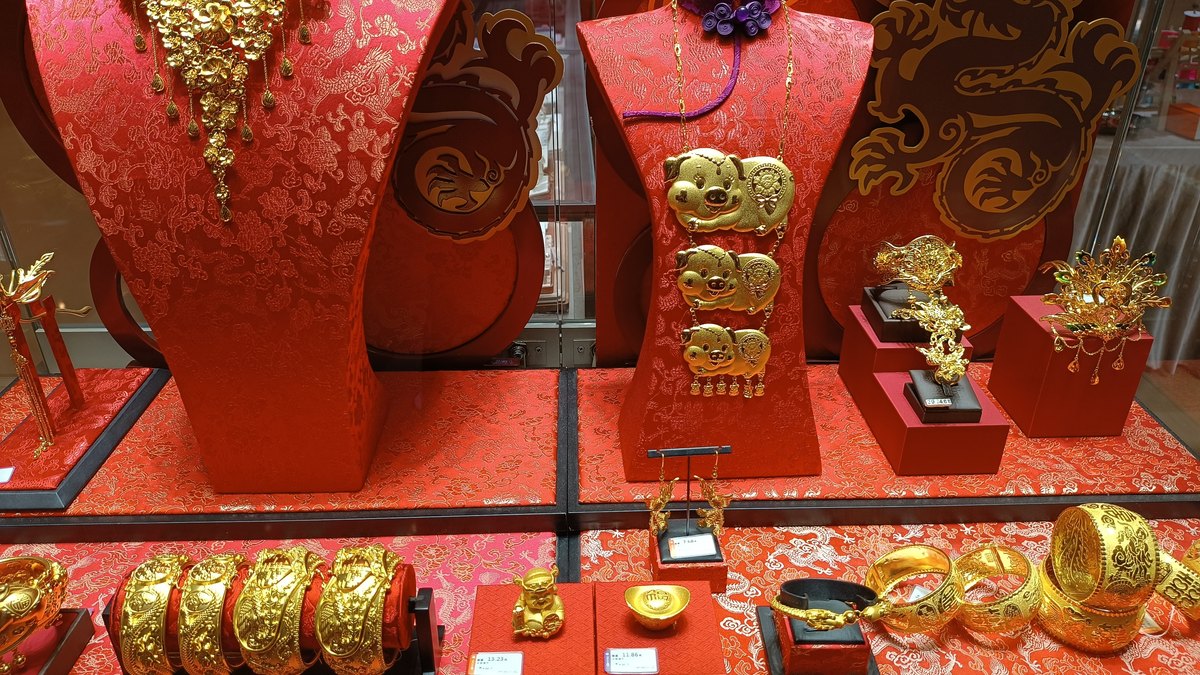
Shuibei in Luohu, Shenzhen, is the largest gold and jewellery industry cluster in the country, home to more than 9,000 gold and jewellery businesses. Its physical gold consumption accounts for roughly 70% of the Shanghai Gold Exchange's physical delivery volume, which is why there's an industry saying: "To see China's jewellery, look to Shenzhen; to see Shenzhen's jewellery, look to Shuibei." This is a wholesale business: gold prices follow the exchange rate plus a fixed labour fee, with no brand premium, so the same piece of gold jewellery can be considerably cheaper than at chain gold shops. That's why in recent years many Hongkongers have made the trip north specifically to buy gold.
Four Major Malls — Which One for Whom?
- Shuibei Wanshan: A veteran big market with the most stalls and the most variety, and the fiercest price competition. Beginners are advised to start here to train their eye
- Jinzhan Jewellery Plaza: On Shuibei First Road, Luohu District, open 09:00–22:00. The mall is more regulated, so after-sales support is relatively more reliable
- Shuibei Jinzuo / Shuibei International Jewellery Trading Center: Mainly serves wholesale buyers, with an astonishing range of designs — good for those looking for a specific style
- IBC Global Business Center (IBC Mall): A mall format that's comfortable to walk around, with jewellery brands and dining. Easiest for first-timers
There are also the Jinli International Jewellery Trading Center, Libofei and others. Walk down one street and it's all gold shops — half a day isn't enough to get through them all.
Transport: Which MTR Station to Get Off At?
- MTR Line 3 or Line 7, Tianbei Station Exit F: Step out and you're at Shuibei Wanshan; walk through Shuibei Wanshan and you reach Jinzhan Jewellery Plaza (most convenient)
- Tianbei Station Exit E: Walk to Jinli International Jewellery Trading Center and Libofei
- MTR Line 3, Shuibei Station Exit B: The IBC Global Business Center area
- ⚠️ Driving or calling a car is not recommended: Shuibei's streets are narrow and often congested — half an hour won't get you 500 metres. The MTR is far more reliable
How Prices Are Calculated: Three Numbers You Must Ask About
- The day's gold price: Follows the Shanghai Gold Exchange's live price. Every stall writes it on their board, and the difference between shops on the same day is very small
- Labour fee: Charged by the gram. Ordinary styles are generally ¥10 to ¥30 per gram; complex craftsmanship (ancient-method gold, hard gold, 5G gold) can reach ¥40 to ¥50 per gram
- Total price: Always ask "how much is it all in?" to confirm whether there are extra charges such as design fees or premium packaging fees. Don't just ask "how much per gram"
Here's a real example calculation (figures are illustrative only, not the actual price of the day): suppose the day's exchange gold price is ¥580/gram and the labour fee is ¥28/gram. Buying a 30-gram bangle, the total would be roughly (580 + 28) × 30 = ¥18,240. If the same piece were at a Hong Kong brand gold shop, you'd also pay design and brand fees — that's where the price gap comes from.
Priced by Gram vs Fixed Price
Shuibei has two ways of selling: "priced by gram" (gold price + labour fee) and "fixed price" (a single total). If you want to preserve value, always choose priced by gram — when fixed-price products are recycled back in Hong Kong or at mainland gold shops, they usually only recognise weight and purity, and the design and craftsmanship fees you paid evaporate. Losses can reach 40%. Only consider fixed-price styles if you're buying purely for looks and treating it as a consumable.
The Three-Step Inspection
- Weigh on the spot: Before paying, ask the shop to re-weigh it on their precision electronic scale and compare with the labelled weight. If the discrepancy exceeds 0.01 grams, ask questions
- Check the hallmark and craftsmanship: Pure gold 999 or above must have a visible hallmark. Use a magnifier to check the joints — the solder points on machine-made pieces and handmade ancient-method gold are clearly different
- Get the receipt: Always obtain a detailed receipt stating the weight, purity (pure gold 999), itemised labour fees and the shop name. It's your only proof for any future dispute
Border Crossing Notes (Many People Get This Wrong)
- Returning to Hong Kong: Hong Kong is a free port. Bringing gold into Hong Kong requires no customs declaration and incurs no duty. Gold is also not a "cash-like instrument" requiring declaration under the law (the HK$120,000 threshold in that ordinance refers to cash and bearer instruments, not gold bars or jewellery)
- Returning to the mainland: The reverse requires attention — mainland customs rules state that travellers bringing gold products into the mainland must declare anything over 50 grams; 50 grams or under is released duty-free. So taking your purchase back to Hong Kong this time is fine, but next time you bring it up to the mainland, do the maths carefully
- For large quantities or gold for commercial use, both sides require formal declaration. Don't rely on the words "personal use" to get through
- Keep receipts and certificates so you have proof if you're ever stopped
Beginner's Workflow: From Arrival to Departure
- Do a lap first without buying: Walk Shuibei Wanshan and Jinzhan Jewellery Plaza, note the marked prices and labour fees for the same styles, and get a feel for the market before committing
- Ask all three numbers: The day's gold price, the labour fee per gram, and what the total includes (whether design fees or premium packaging fees are extra)
- Negotiate: Labour fees are negotiable. Buying multiple pieces at once, or pointing out that the labelled craftsmanship description doesn't match the actual item, usually gets you a discount
- Re-weigh and check the hallmark: Only accept pure gold 999 or above with a weight discrepancy within 0.01 grams
- Pay and get the receipt: The receipt should state the weight, purity, labour fee, shop name and date. Take photos of the shop sign and the testing certificate while you're at it
What's the Best Value?
Plain gold priced by gram (gold bars, gold granules, plain bangles, simple necklaces) has the lowest labour fee and the best value retention. Ancient-method gold and hard gold have higher labour fees but are durable and beautifully styled. For settings (diamonds, gemstones), you need to look separately at the stone's certificate and quality — you can't judge value by the gold price alone.
Practical Tips for Hongkongers
- Set off before 9am on a weekday to avoid weekend and holiday crowds, giving yourself plenty of time to choose
- Allow at least half a day: choosing styles, trying them on, re-weighing and calculating labour fees all take time. Rushing makes it easy to miss things
- Compare three shops — the same style can differ by tens of percent in labour fee between stalls, and haggling usually works
- Don't impulse-buy "limited edition, last piece" — the one thing Shuibei never lacks is gold shops. If a stall has a bad attitude or refuses to re-weigh, just walk away
- You can pay by WeChat/Alipay (linked to a Hong Kong credit card) or a mainland bank card. Work out the exchange rate first and compare the total cost
FAQ
Is buying gold in Shuibei always cheaper than Hong Kong?
The gold material itself follows the international gold price, so it's about the same in both places. The difference lies mainly in labour fees and brand premiums. Shuibei prices by gram with low labour fees, so the same style of gold jewellery is usually cheaper than at Hong Kong brand gold shops — but you have to factor in your travel costs and time.
Could I end up buying fake gold?
Stalls in large markets and malls generally have testing certificates and receipts, so there's recourse if something goes wrong. What to watch out for are labour-fee traps, fixed-price products and "last batch from the factory" sales talk. Don't just take the salesperson's word for it.
Do I need to declare it when bringing it back to Hong Kong?
No. Hong Kong imposes no duty on gold, and it isn't a cash-like instrument requiring declaration. Conversely, if you later bring gold from Hong Kong into the mainland, anything over 50 grams must be declared.
Can I pay by card or electronic payment?
Most stalls accept WeChat Pay and Alipay, some accept mainland bank cards, and fewer accept credit cards — and those that do may add a handling fee. Best to link your electronic payment in advance.

💬 Comments
Loading…